

If you read my post on why we build walls after betrayal, you’ll already know how past heartbreaks can quietly turn us into Fort Knox in joggers—self-protective, closed off, and secretly a bit lonely underneath it all.
But here’s the bit I didn’t get into there: it’s not just about building emotional walls.
Sometimes, those experiences go deeper.
They don’t just change how we behave…
They change who we are.
🧪 Yes, This Is Backed by Science (Not Just Wine-Fuelled Rants)
Recently, I watched a friend get totally blindsided by their partner doing the horizontal hokey cokey with someone else.
Cue the spiral:
- Dramatic Facebook posts
- Wine-fuelled therapy via WhatsApp
- And the usual declarations of, “I’m never trusting anyone again.”
And if you’ve been through something like that—whether it was cheating, betrayal, a toxic boss, or just being constantly let down by people you trusted—you’ll know the feeling.
It’s easy to think, “I’ve just got higher standards now.”
But what’s actually happening underneath is far more powerful.
A meta-analysis of more than 1,500 studies (yes, we’re getting nerdy) found that major life events—especially the painful, blindsiding ones—can cause core personality traits to shift.
Not just how you react.
Not just how you date.
Your actual personality.
🧠 From Trusting to Suspicious (and Everything In Between)
You might have been naturally open, warm, and trusting. But after one too many betrayals?
- You start evaluating new friends like they’re applying to MI5.
- You feel suspicious of kindness.
- You hold people at arm’s length so they can’t hurt you the way they did.
You didn’t wake up one day and decide to be more closed off.
Your experiences reprogrammed you.
And it’s not just relationship trauma.
- Lost a job? You might become more risk-averse—even outside of work.
- Experienced financial hardship? Suddenly you’re hoarding random things “just in case” (yes, even the drawer of takeout sauces).
- Went through betrayal? You now filter everyone through the “potential backstabber” lens.

🔄 But Not Everyone Reacts the Same Way
Here’s where it gets interesting.
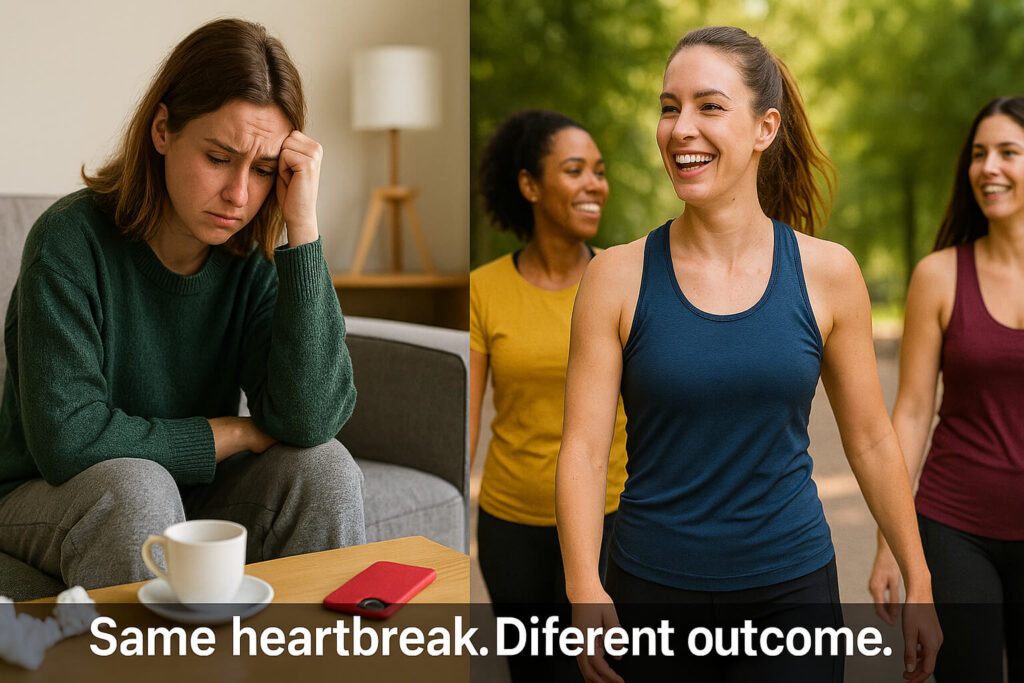
Two people go through the exact same thing—let’s say, both got cheated on.
- One builds the emotional equivalent of a medieval fortress and vows to trust no one ever again.
- The other decides to reflect, rebuild, and choose differently next time.
Same event. Different story.
And this is what I want you to take from today:
It’s not what happens to you. It’s how you respond.
🏋️♀️ And Yes, This Also Applies to Fitness (Of Course It Does)
Because how you handle setbacks in life is the same as how you handle them in your health journey.
You’ve probably had a moment where something went sideways:
- You got injured.
- You “failed” another diet.
- You got stuck in a hoodie in the changing room because the fluffy lining fused to your sweaty skin and you had to perform a slow-motion escape act that made you question every life choice leading up to that moment. (I’m still not over that one).
You can use that as evidence that fitness “just isn’t for you.”
Or you can learn from it, adapt, and try again—wiser, stronger, and maybe with better leggings.
🔁 Perspective Is the Pivot Point
This article isn’t just about betrayal or heartbreak—it’s about every time life hits you with something unexpected and unkind.
You can’t always control what happens.
But you can always control what it turns you into.
If you’ve found yourself becoming someone you don’t recognise—more guarded, less joyful, suspicious by default—it might not be you at all.
It might just be who you became to survive something you didn’t deserve.
But survival isn’t the end goal.
Reconnection is.
And if you’re ready to start peeling back those layers—to not just survive but feel more like yourself again—start by noticing the story you’re telling yourself.
Is it one of protection? Or one of growth?
Both are valid. But one will keep you stuck.
👉 Want to dive deeper into how these walls get built in the first place?
Go check out my post on how emotional armour keeps us lonely.
Have you noticed any changes in how you show up after going through something tough?
What’s one way you’ve bounced back or grown that surprised even you?
Drop your thoughts in the comments—I’d genuinely love to hear how you’ve navigated your own plot twists.
And if this post gave you a moment of clarity, made you laugh, or just made you feel a little less alone… hit one of the share buttons. Someone else out there might need to read this too.