
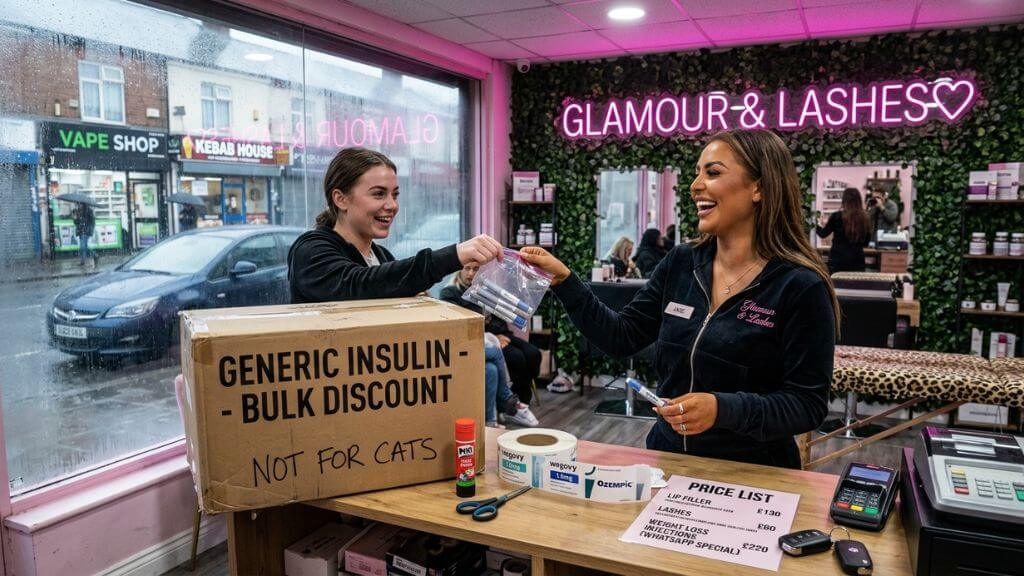
There is a distinct, uniquely British type of madness currently unfolding across the country, and it has officially crossed the line from comically sketchy to flat-out lethal.
If you needed a life-saving heart medication or an intensive course of antibiotics, you would not source it via an encrypted group chat from a man named “Big Gaz” who delivers out of the back of a 2018 Vauxhall Astra. You would not buy it from an anonymous TikTok account whose profile picture is a stolen photo of a Rolex, and you certainly wouldn’t pick it up from a local high-street beauty salon positioned precariously between a vape shop and a kebab house.
Yet, when it comes to weight loss injections, millions of otherwise completely rational Brits have collectively decided to suspend all basic survival instincts.
Driven by intense NHS cost pressures, restricted eligibility access, and massive price hikes in the private sector, the black market has stepped into the gap. Over the last month, the MHRA (the UK’s medicines regulator) and police forces have been executing massive, coordinated raids on underground distribution networks, seizing thousands of illicit doses from Northampton to Birmingham.
The reality filtering out of those raids is terrifying: the UK is currently swimming in counterfeit weight loss pens. And they are putting unsuspecting people directly into emergency room comas.
The Beauty Salon Side-Hustle
For the last couple of years, we have tolerated the “DIY cowboy culture” of online pharmacies handing out prescriptions via a three-question multiple-choice quiz. But the black market has officially cut out the middleman.
We have moved firmly into the era of the WhatsApp pharmacy.
Local aesthetics clinics, places that traditionally stuck to eyebrow laminations, lip filler, and the occasional botox top-up, have systematically transformed into bootleg pharmaceutical dispensaries. Sourcing their stock from the digital equivalent of a dark alleyway, these unregulated setups are capitalising on sheer desperation.
If your medical provider also offers a half-price Hollywood wax, a loyalty card for fake tan, and sends a broadcast text to 400 people saying “Fresh batch of Mounjaro just landed girls, cash only, DM to secure xxx,” you are not receiving medical care. You are participating in a low-rent high-street cartel.
People who wouldn’t eat a sandwich if the wrapper looked a bit dodgy are willingly handing over hundreds of pounds via bank transfer to completely unverified strangers. They receive an unboxed, unlabelled plastic pen in a padded envelope, and casually inject a mystery liquid directly into their abdominal walls before heading off to work.
The Lethal Bait-and-Switch: The Insulin Coma
This is where the sketchy high-street comedy stops and the cold, hard clinical reality sets in.
Criminal syndicates are not operating highly sophisticated, sterile chemical laboratories to manufacture actual Semaglutide or Tirzepatide. That requires billions of pounds of specialised medical infrastructure. Instead, they are doing something far cheaper, simpler, and infinitely more malicious.
They are buying mass quantities of cheap, generic, bulk insulin pens. They are peeling off the original manufacturer labels, printing out high-quality counterfeit “Wegovy,” “Mounjaro,” or “Ozempic” stickers on basic adhesive paper, and selling them to desperate buyers online.
The biological consequence of this is catastrophic.

When you inject a genuine weight loss jab, it mimics a gut hormone to turn your stomach into a slow, lazy concrete mixer. When you inject a massive, unmetered dose of insulin into a body that is not diabetic, you have effectively pulled the pin on a metabolic hand grenade.
Insulin’s sole job is to aggressively strip glucose out of your bloodstream. Within minutes of taking a fake pen, your blood sugar crashes to absolute zero. Your brain, which relies entirely on glucose to keep the lights on, is suddenly starved of fuel. It is the physiological equivalent of a panicked night watchman shutting down the entire national grid with a single switch.
UK A&E departments are now regularly treating patients who are arriving via blue-light ambulances in profound, hypoglycaemic shock. They are experiencing severe seizures, irreversible brain swelling, and permanent neurological damage. They didn’t want to cheat a diet; they just wanted a quick fix before a summer holiday, and they ended up on life support because they trusted a stranger’s Instagram story.
How to Spot a Counterfeit Pen: The Reality Check
We have to drop the polite consumer etiquette entirely. If you are buying these tools outside of a regulated, mainstream British pharmacy, you are playing Russian roulette with a loaded syringe.
If you currently have a pen sitting in your fridge next to the milk, go look at it right now. Here are the definitive red flags that mean your pen belongs in a hazardous waste bin, not your thigh:
- The Packaging Strip-Down: Genuine weight loss pens arrive in a pristine, tamper-proof pharmaceutical box with an official patient information leaflet printed in perfect English, alongside sterile, individually wrapped needles. If your pen was handed to you in a clear ziplock bag, a velvet jewellery pouch, or wrapped in bubble wrap with a rubber band, it is a fake.
- The Scale Dial Discrepancy: Look at the dosing window. A genuine Ozempic or Wegovy pen has a highly specific, engineered clicking dial that locks into exact doses (like 0.25mg or 1.0mg). Many counterfeit pens use cheap, generic insulin barrels where the dial spins loosely or shows standard “units” (1 to 60) rather than milligrams.
- The Label Text Check: Look incredibly closely at the sticker on the actual plastic barrel. Counterfeits frequently have slight alignment errors, blurry font printing, or labels that peel back easily at the corners because they were stuck on by hand in a kitchen, not by a sterile medical robot.
The Ultimate Bottom Line
The desire to take a shortcut is a powerful human emotion. The black-market gangs know this, and they are actively weaponising your insecurities to fund their operations, completely indifferent to whether you wake up in an intensive care unit or don’t wake up at all.
If you cannot verify the exact General Pharmaceutical Council (GPhC) registration number of the website or provider handing you that medication, do not put it in your body. Being frustrated with limited NHS access or high private healthcare fees is a temporary inconvenience. An insulin-induced coma is a permanent catastrophe. Stop treating your personal biochemistry like a casual internet purchase.