
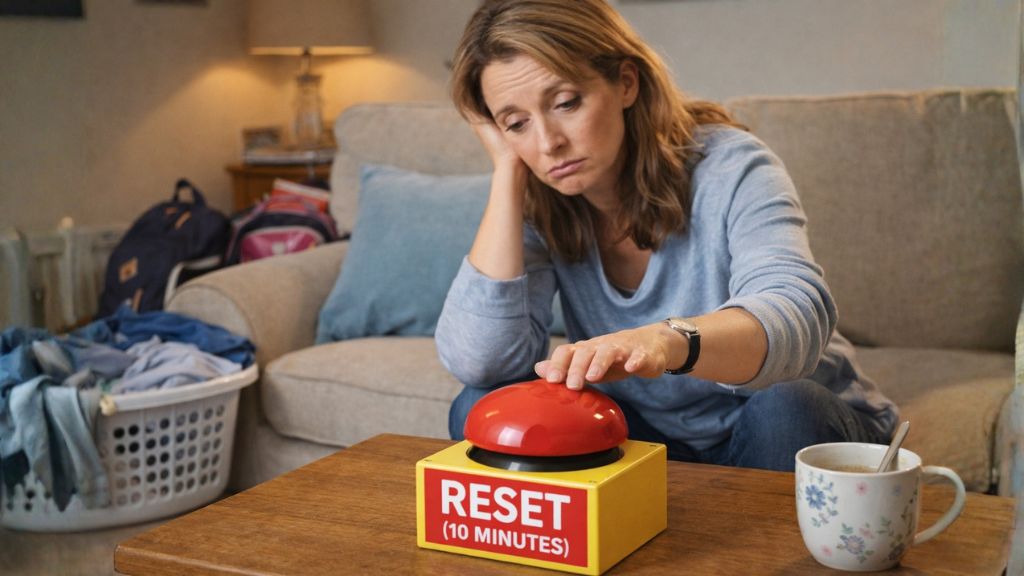
When people hear the word exercise, they often picture punishment. Lycra they don’t want to wear, a workout they don’t have time for, and the faint sense that if they’re not absolutely nailing it, they might as well not bother at all.
For most busy women, though, the real win isn’t smashing workouts or “pushing through.” It’s having a reliable reset button — something that helps you feel better quickly and stops the day from sliding completely off the rails.
This is that reset.
Ten minutes of simple movement you can do at home, in normal clothes, without turning it into a full-blown production. It’s not about burning the most calories or earning your dinner. It’s about lowering stress, lifting your mood, and stopping the “I’ve lost the plot, so I may as well sack it off” spiral before it takes the wheel.
Why short movement works (especially when you’re stressed)
When you’re overwhelmed, your brain isn’t interested in long-term goals. It’s in survival mode. That’s why motivation disappears and everything feels harder than it should.
Short bursts of movement work because they give your nervous system a gentle nudge, not a shock. You move your body, your breathing deepens, your muscles wake up, and your brain gets the message that things are… manageable.
You’re not trying to exhaust yourself. You’re reminding your system that you’re safe, capable, and still in control. That shift alone can make the rest of the evening feel very different.
And crucially, ten minutes doesn’t trigger resistance. Your brain doesn’t argue with it. It just goes, “Fine. I can do that.”
The 10-Minute Reset (That Still Feels Like Exercise)
This isn’t rehab. And it’s not a gentle stretch while listening to whale sounds either.
It’s a short, purposeful burst of movement designed for days when you’re tired, stressed, or can’t face a full workout — but still want to feel like you’ve done something useful.
Think: heart rate gently up, muscles switched on, head a bit clearer.
Here’s a simple structure that works for most people:
Minute 1–2: Get moving
Marching, step-backs, or brisk walking on the spot. Just enough to wake your body up and shake off that “stuck at a desk all day” feeling.
Minute 3–6: Big, simple movements
Pick 3–4 exercises and cycle through them:
- Squats or sit-to-stands
- Wall push-ups or incline push-ups
- Reverse lunges or step-backs
- Dumbbell or bodyweight rows
Nothing fancy. Nothing extreme. Just solid, full-body moves that remind your muscles they still have a job.
Minute 7–9: Keep the momentum
Repeat the same moves, slightly quicker, or shorten the rest. You should feel warm, slightly out of breath, and like your body has properly “come online”.
Minute 10: Downshift
Slow it back down with a minute of deep breathing and gentle movement. Not because you’re fragile — but because finishing calm helps lock in the stress-relief effect.
This kind of movement doesn’t just “count”. It makes everything else easier — mood, food choices, sleep, and consistency.
And on days when motivation is low, ten minutes like this is often the difference between stopping altogether and keeping the habit alive.

If your knees, back, or energy are not on board
Some days your body will feel great. Other days it will feel like it’s made of biscuits.
On those days:
- Keep everything upright
- Reduce range of motion
- Slow it right down
- Swap squats for sit-to-stands
- Swap lunges for stepping back one foot at a time
The rule is simple: movement that feels doable still counts. Especially on the days you’re tempted to do nothing.
When to use the reset
This works best when you use it as a tool, not a task.
Good times to deploy it:
- Straight after work, before you sit down “for five minutes”
- Before dinner, to reset stress eating
- During overwhelm, when your head’s racing
- Before bed, as a physical exhale
- On days when motivation has fully clocked off
You don’t need to schedule it perfectly. You just need to notice the moment things start wobbling.
How this becomes a habit (without willpower heroics)
Consistency doesn’t come from motivation. It comes from removing friction.
Think:
- Same time each day
- Same place
- Same trigger (kettle on, work laptop shut, school run finished)
This is your minimum viable day. Even if everything else goes out the window, you’ve kept the promise.
Over time, that does something powerful. You stop seeing yourself as “on or off the wagon” and start seeing yourself as someone who shows up — even imperfectly.
That’s where real consistency lives.

Why this matters beyond weight loss
Movement isn’t just about bodies. It’s about regulation.
Short, accessible movement helps children and adults alike:
- Settle emotions
- Improve focus
- Reduce anxiety
- Build resilience through action, not talk
That’s why even schools now use movement breaks to support learning and wellbeing. The principle is the same here: move the body, calm the mind, then deal with what’s next.
Bottom line
You don’t need more intensity. You need something you’ll actually do when life feels loud.
Ten minutes.
No guilt.
No drama.
Just a reset that brings you back to yourself.