
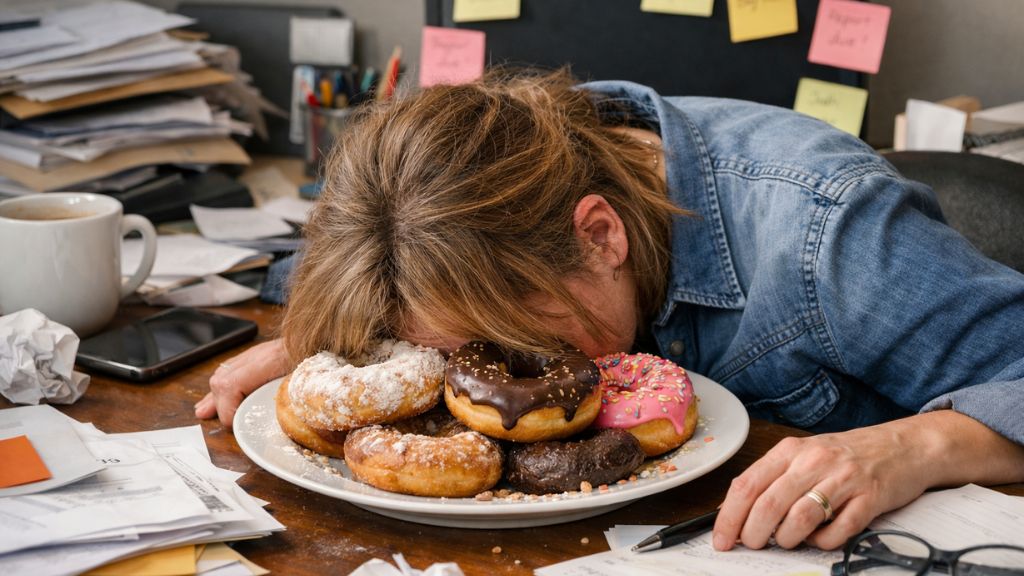
If you’ve ever been fine all day — capable, busy, holding it together — and then suddenly found yourself rummaging for something sweet, salty, crunchy, or all three at once… you’re not broken. You’re not weak. You’re not “out of control”.
You’re human.
Stress eating is rarely about hunger and almost never about a lack of willpower. It’s often your nervous system looking for a quick gear change. Food is fast comfort, fast distraction, and sometimes the quickest way your body knows how to downshift after a long day of holding everything together.
The good news? You don’t need to “be stricter” or ban half your kitchen to fix this. You can keep the comfort — without it becoming an automatic habit that leaves you feeling worse afterwards.
What’s actually happening when stress cravings hit
When you’re stressed, your body is in alert mode. Even if nothing dramatic is happening, your system is still running on caffeine, deadlines, responsibility, and low-level pressure.
In that state, your brain is not interested in long-term goals. It wants relief. Quickly.
Food works because it:
- Calms the nervous system (especially carbs and fats)
- Distracts you from emotional overload
- Feels predictable and reliable when everything else has been demanding
So when cravings hit at night, it’s not because you’ve suddenly lost all discipline. It’s because your system is saying, “Can we please stop now?”
6 common stress-eating triggers (see how many feel familiar)
Stress eating often follows patterns, not hunger signals. Common triggers include:
- After work – when you finally stop and everything you’ve been holding back turns up at once
- After the kids’ bedtime – when the house goes quiet and your body realises how tired you are
- Arguments or tension – food as a way to soothe or avoid sitting with emotion
- Loneliness – especially in the evenings when distraction runs out
- Exhaustion – when decision-making capacity has fully left the building
- “I deserve it” moments – not wrong, just often hijacked by stress rather than enjoyment
None of these mean you’re failing. They mean you’re responding normally to pressure.
The 3-minute pause (this is the game-changer)
You don’t need to “stop” stress eating completely. You just need to interrupt autopilot.
When a craving hits, try this 3-minute pause:
1. Breathe (1 minute)
Slow inhale through your nose, longer exhale through your mouth. Nothing fancy. Just enough to tell your nervous system you’re safe.
2. Body check (1 minute)
Ask yourself: What do I actually need right now?
Rest? Warmth? Comfort? Quiet? Protein? A break from everyone?
3. Choose (1 minute)
You’re allowed to eat. You’re also allowed to choose how you eat. The pause gives you options instead of reflex.
Sometimes you’ll still have the snack. Sometimes you won’t. Either way, you’re back in the driver’s seat.

10 comfort swaps that aren’t sad diet food
These aren’t “better choices” — they’re same job, less spiral options.
- Greek yoghurt with honey or berries
- Hot chocolate made with milk and cocoa
- Cheese and crackers (plated, not grazed)
- Popcorn with salt or butter
- A banana with peanut butter
- Soup or broth in a mug
- Warm toast with something savoury
- Protein bar you actually enjoy
- Roasted chickpeas or crunchy peas
- A proper sit-down cuppa with a biscuit you plan to eat
Comfort doesn’t need to mean chaos.
Set up your kitchen to help you (without banning food)
Your environment matters more than motivation.
A few simple tweaks:
- Keep protein and easy meals visible at eye level
- Put “snacky” foods somewhere slightly less convenient (not hidden, just not shouting at you)
- Portion snacks instead of eating from the packet
- Create a default evening option you don’t have to think about
This isn’t about control. It’s about making the calm choice the easy one.
If you do overeat — here’s what not to do
Do not:
- Skip meals the next day
- Punish yourself with exercise
- Start again on Monday
- Talk to yourself like you’re a disappointment
That just keeps the cycle going.
Instead:
- Eat normally at your next meal.
- Drink some water.
- Move gently.
And remind yourself: One episode doesn’t undo anything.
The fastest way out of stress eating is kind consistency, not punishment.
Stress eating isn’t a sign that something’s wrong with you. It’s often a sign that your system has been working hard for a long time and is looking for a way to stand down.
When you stop treating cravings like a moral failure and start responding to them as information, everything softens. You make calmer choices. You recover faster. And food stops feeling like something you need to fight.
Support the nervous system, and the behaviour usually follows.